> ## Documentation Index
> Fetch the complete documentation index at: https://docs.vendo.run/llms.txt
> Use this file to discover all available pages before exploring further.
# Mastra
> What the quickstart left out for a Mastra agent: the static definition, the request-context caller, warming the store, and the model pin.
The [quickstart](/existing-agent/quickstart) wires a Mastra agent end to end. This page is the rest.
## The definition is static, the caller is not
One Mastra agent definition serves every user, so `vendoMastraTools` takes no principal. Each call reads one off Mastra's request context, and a `vendo_*` call that finds none fails closed.
```ts app/api/chat/route.ts focus={13-15} theme={null}
import { handleChatStream } from "@mastra/ai-sdk";
import { RequestContext } from "@mastra/core/request-context";
import { VENDO_PRINCIPAL_KEY } from "@vendoai/vendo/mastra";
import { createUIMessageStreamResponse } from "ai";
import { resolvePrincipal } from "@/lib/vendo";
import { mastra } from "@/mastra";
export async function POST(req: Request) {
const params = await req.json();
const caller = await resolvePrincipal(req);
if (!caller) return new Response("Unauthorized", { status: 401 });
const requestContext = new RequestContext();
requestContext.set(VENDO_PRINCIPAL_KEY, caller);
params.requestContext = requestContext;
const stream = await handleChatStream({ version: "v6", mastra, agentId: "your-agent", params });
return createUIMessageStreamResponse({ stream });
}
```
`resolvePrincipal` is the `lib/vendo.ts` export from the [quickstart](/existing-agent/quickstart), unchanged here.
A context you build and never pass is a context the tools never see. Skip the `params.requestContext` assignment and every `vendo_*` call fails, which reads at first glance like a broken install.
Set `VENDO_SESSION_KEY` on the same context to carry your own session id into the audit trail. Leave it out and each call mints one.
That subject has to match what your wire route's `principal` resolves. If they disagree, the person never sees what the agent makes, and the app embed polls forever while the agent reports success.
Resolve both from the same session, and never take a principal from the client. See [Auth](/production/auth).
`vendoMastraTools` returns a Promise, which is why the agent takes the tools-as-function form.
```ts src/mastra/agents/your-agent.ts focus={10} theme={null}
import { Agent } from "@mastra/core/agent";
import { vendoMastraTools } from "@vendoai/vendo/mastra";
import { vendo } from "@/lib/vendo";
export const yourAgent = new Agent({
id: "your-agent",
name: "your-agent",
instructions: "…your system prompt as it is",
model: "openai/gpt-4.1-mini", // see the pin below
tools: async () => ({ ...(await vendoMastraTools(vendo)) }),
});
```
## Warm the store
Every `vendo_*` call runs the schema check before it executes, so a guarded tool that fires before any wire request still works. Call `ensureSchema` once at module scope to move that one-time cost off the first turn.
```ts src/mastra/index.ts focus={3} theme={null}
import { vendo } from "@/lib/vendo";
await vendo.store.ensureSchema();
```
## Render the parts
Mastra streams tool calls as `dynamic-tool` or as `tool-`, depending on how the tool was declared. Match both.
Where that match lives is yours. The path below is a name, not a contract — only your own chat imports it, so a `components/` directory you do not have is a directory you do not need. [`examples/mastra-agent`](https://github.com/runvendo/vendo/tree/main/examples/mastra-agent) inlines the same branch in `src/app/page.tsx` instead.
```tsx components/vendo-part.tsx focus={5-8} theme={null}
import { getToolName, isToolUIPart, type UIMessage } from "ai";
import { VendoToolResult } from "@vendoai/vendo/react";
export function VendoPart({ part }: { part: UIMessage["parts"][number] }) {
if (!isToolUIPart(part)) return null; // true for both shapes
return part.state === "output-available"
?
: Running {getToolName(part)}…;
}
```
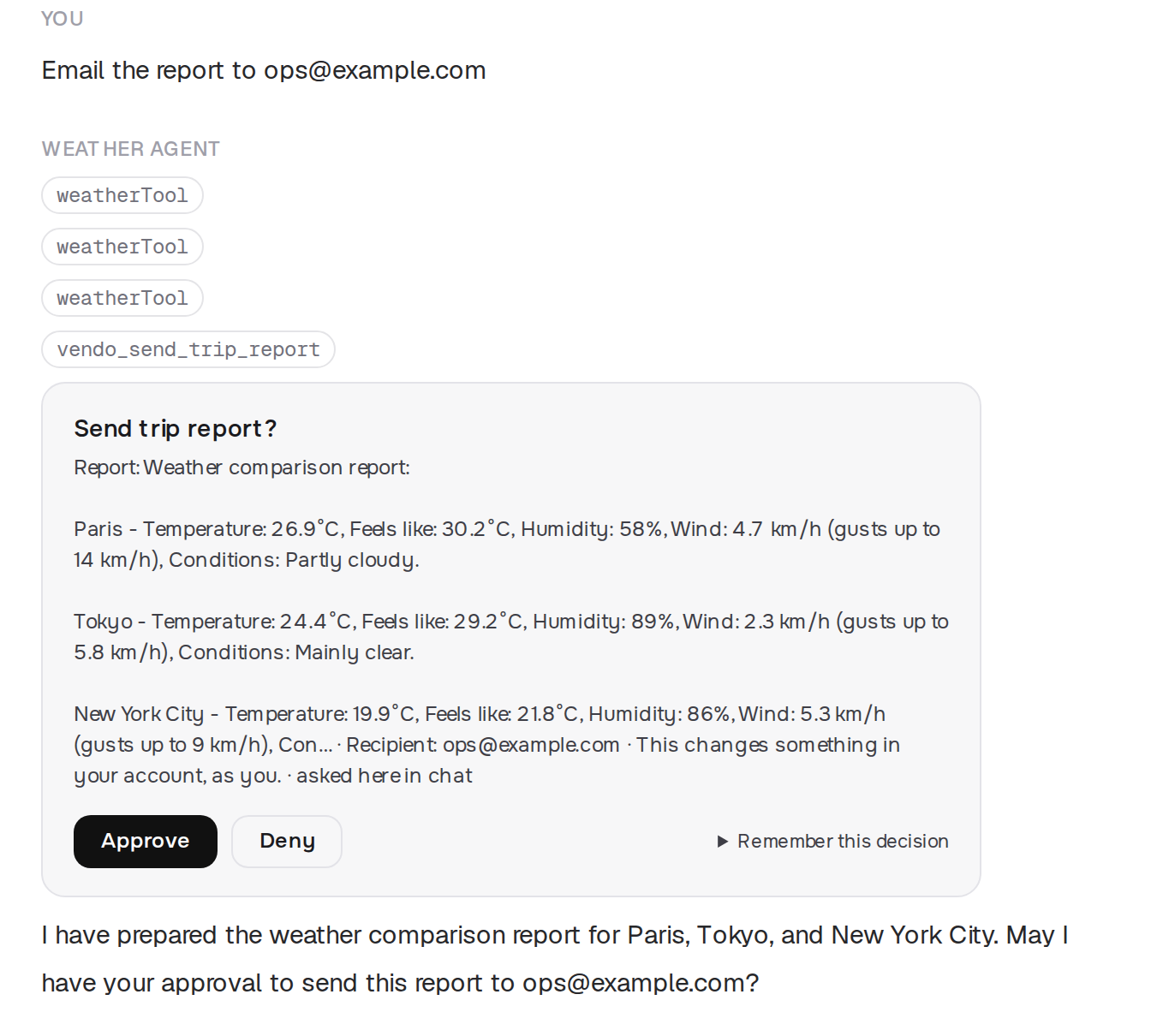
Everything downstream of that is the same as any other framework. Full contract: [Embeds in your chat](/existing-agent/embeds).
 ## Open input schemas ride a bridge
Extraction emits an open object schema for a route whose body shape it cannot type. Mastra's provider compat layers hard-close every object node, so an open schema reaches the model as "this tool takes no arguments", and the model then calls it with `{}`.
The shim routes those tools through one declared `args` property instead, a JSON object or that object as a JSON string, and unwraps it before the guard. Nothing on your side changes.
## The model pin
Multi-turn tool use with GPT-5 reasoning models breaks on history replay. Mastra's memory drops the Responses API's reasoning items and the second turn errors.
[mastra-ai/mastra#9005](https://github.com/mastra-ai/mastra/issues/9005) is closed, but it still reproduces on `@mastra/core` 1.51.0, retested 2026-07-20, so the example pins `openai/gpt-4.1-mini`.
Your agent's model is your call. Vendo's own turns take a seat of their own, filled through the Cloud gateway on your `VENDO_API_KEY`: [Model credentials](/production/model-credentials).
## The full example
[`examples/mastra-agent`](https://github.com/runvendo/vendo/tree/main/examples/mastra-agent) is the stock [`create-mastra`](https://mastra.ai/docs) weather starter, fronted with Next.js per Mastra's guide, with this diff applied. Every added line sits between `--- vendo` and `--- /vendo` markers, about sixty of them in total.
## Open input schemas ride a bridge
Extraction emits an open object schema for a route whose body shape it cannot type. Mastra's provider compat layers hard-close every object node, so an open schema reaches the model as "this tool takes no arguments", and the model then calls it with `{}`.
The shim routes those tools through one declared `args` property instead, a JSON object or that object as a JSON string, and unwraps it before the guard. Nothing on your side changes.
## The model pin
Multi-turn tool use with GPT-5 reasoning models breaks on history replay. Mastra's memory drops the Responses API's reasoning items and the second turn errors.
[mastra-ai/mastra#9005](https://github.com/mastra-ai/mastra/issues/9005) is closed, but it still reproduces on `@mastra/core` 1.51.0, retested 2026-07-20, so the example pins `openai/gpt-4.1-mini`.
Your agent's model is your call. Vendo's own turns take a seat of their own, filled through the Cloud gateway on your `VENDO_API_KEY`: [Model credentials](/production/model-credentials).
## The full example
[`examples/mastra-agent`](https://github.com/runvendo/vendo/tree/main/examples/mastra-agent) is the stock [`create-mastra`](https://mastra.ai/docs) weather starter, fronted with Next.js per Mastra's guide, with this diff applied. Every added line sits between `--- vendo` and `--- /vendo` markers, about sixty of them in total.